The First Time I Designed Horizontally
Most of my bookcases are taller than they are wide. This piece was different.
The customer had previously purchased one of my bookcases and wanted something for a Japanese inspired bedroom. Rather than another tall vertical piece, they wanted something low and wide that would stretch horizontally through the room. There was a practical reason for that choice. Horizontal furniture preserves wall space and allows wider objects such as televisions, artwork, and decorative objects to become focal points within the room. Designing a piece with those proportions required a different way of thinking. When a piece becomes wider than it is tall, the challenge shifts from creating height and presence to creating movement across a long span. This project became one of the first times I explored that challenge in depth.

A major inspiration for the design came from traditional Japanese architecture. Many traditional Japanese homes include tana, which are decorative shelving recesses often found alongside a tokonoma, an alcove used to display calligraphy, artwork, flowers, or other cherished objects. These shelving arrangements frequently feature staggered shelves that create visual interest while also serving a practical purpose. I wanted to bring that idea into furniture form.
The staggered shelving became one of the defining features of the piece. Beyond simply providing storage, the shelves create a rhythm that guides the eye across the furniture. Instead of taking in the entire piece at once, the viewer naturally moves from one shelf to the next, discovering the composition as they go. When I first sketched the design, I felt confident it would work. The staggered shelves immediately felt like the right solution for breaking up the long horizontal span while staying true to the Japanese architectural influences that inspired the project.

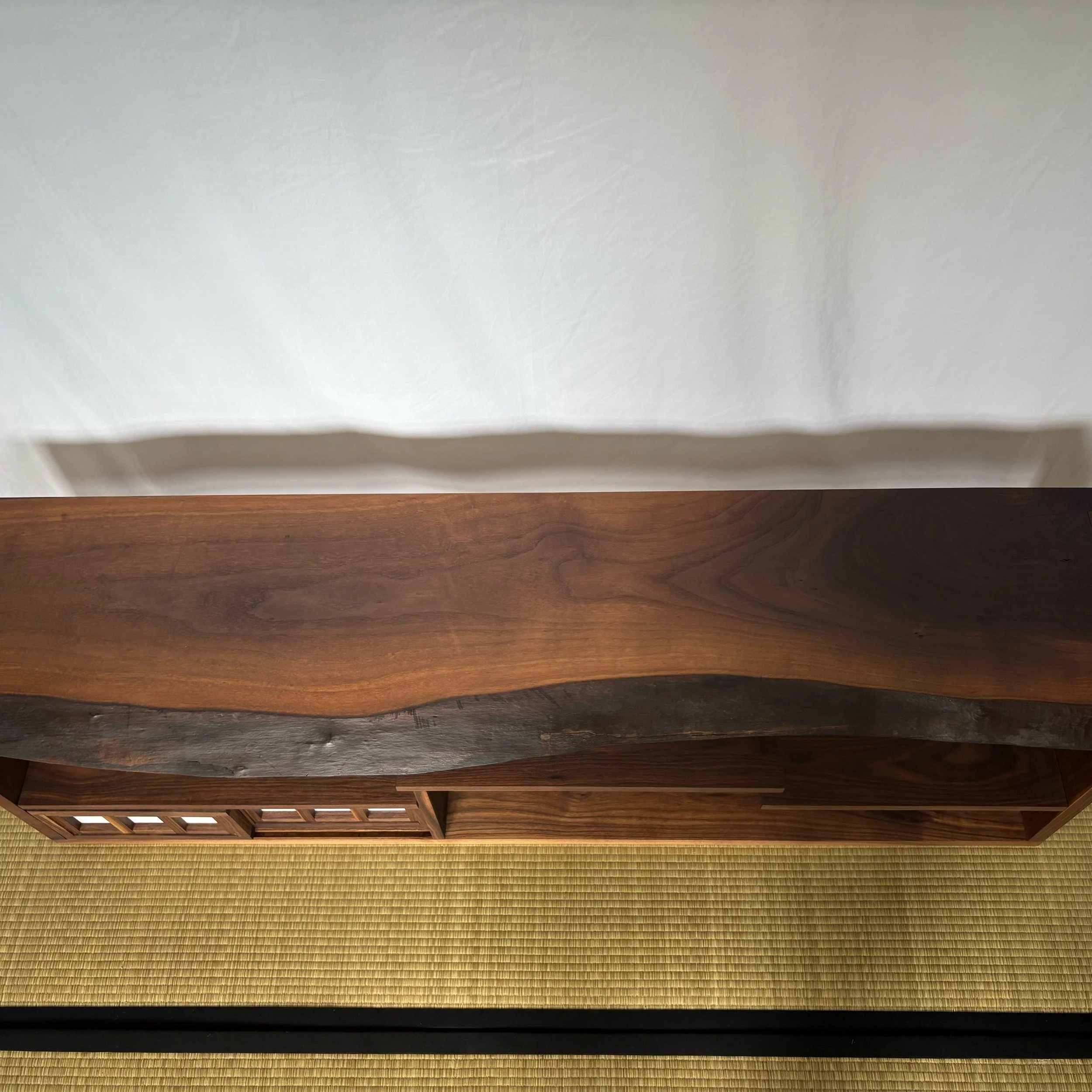
Another important design decision was the live edge walnut top. A perfectly straight top would have created a more formal appearance, but the live edge introduced a sense of movement and natural character. It ensures that this piece can never be perfectly replicated. Even if I built another cabinet with identical dimensions and shelving, the shape of the live edge would make it unique.
What surprised me most after the piece was finished was just how effective the live edge became. I expected it to add some visual interest, but it ended up contributing far more movement and personality than I anticipated. Looking back, it almost feels like a roofline floating above the more structured elements below. The contrast between the organic edge and the geometric shelving creates a balance that became one of my favorite aspects of the design.
This project was also the first time I incorporated a sliding compartment into one of my furniture designs. The doors were inspired by traditional shoji panels, which are made from wooden latticework covered with washi paper. Rather than making the compartment the centerpiece of the piece, I wanted it to feel like a natural extension of the overall composition.
Looking back, that balance is probably what I am most proud of. The shoji compartment is noticeable without dominating the design. It feels integrated into the shelving rather than competing with it. The shelving creates movement while also providing practical storage, and the shoji doors add another architectural detail without disrupting the overall flow. Together they create a piece that feels balanced despite being intentionally asymmetrical.

This project also taught me an important lesson about designing long horizontal furniture. Large spans need variation. Without something to break up the space, the eye can quickly lose interest. The staggered shelving creates visual resting points and helps the furniture feel dynamic rather than static. That lesson continues to influence how I approach long furniture pieces today.
The project also changed my understanding of scale. On paper, the design felt fairly modest. Once it was built, however, it felt much larger than the drawings suggested. That experience taught me to pay much closer attention to how horizontal furniture occupies a room and how proportions are perceived in real life rather than on a sketch.
This piece remains one of the more unique designs I have created. While many of the ideas differ from my current work, it represents an important evolution of my bookcase designs and a deeper exploration of Japanese architectural influences. My design philosophy has always been rooted in traditional Japanese architecture, and that influence is visible throughout the piece. The staggered shelving, the shoji compartment, and the emphasis on balance and movement all trace their origins back to architectural ideas that have inspired me for years.
If I were to build this piece again today, I would not change much about the structure itself. Instead, I would likely experiment with contrasting woods such as cherry or figured maple to introduce another layer of visual interest while preserving the original design. Furniture design is often a process of refinement rather than reinvention. Sometimes the goal is not to create something completely different. Sometimes the goal is simply to take an idea that already works and continue exploring it.
If you're interested in discussing a custom furniture project of your own, I'd love to hear your ideas. Many of my favorite pieces began as conversations with clients who were looking for something they couldn't find anywhere else.
You can learn more about custom commissions here or email me with your ideas at dylan@flowingwaterwoodworking.com.
