Revisiting an Early Design: A Live Edge Oak Console with Staggered Maple Shelves
Some designs disappear after they are built. Others stay in the back of my mind because there is something worth returning to.
Years ago, I built a live edge walnut console table with a single lower shelf held in place by exposed tusk tenons. It was one of the earlier pieces where I began treating joinery as something worth showing rather than hiding. The idea was simple, and I liked it enough that elements of the design continued appearing throughout my later work.

Recently, I had the opportunity to revisit it.
My aunt had always liked the original table and wanted a version of her own, but with a lighter appearance that would sit comfortably alongside some of the weathered and reclaimed-wood tones already present in her home. Rather than simply reproducing the old piece, I treated the project as a chance to rebuild the concept around everything I had learned since making the first one.
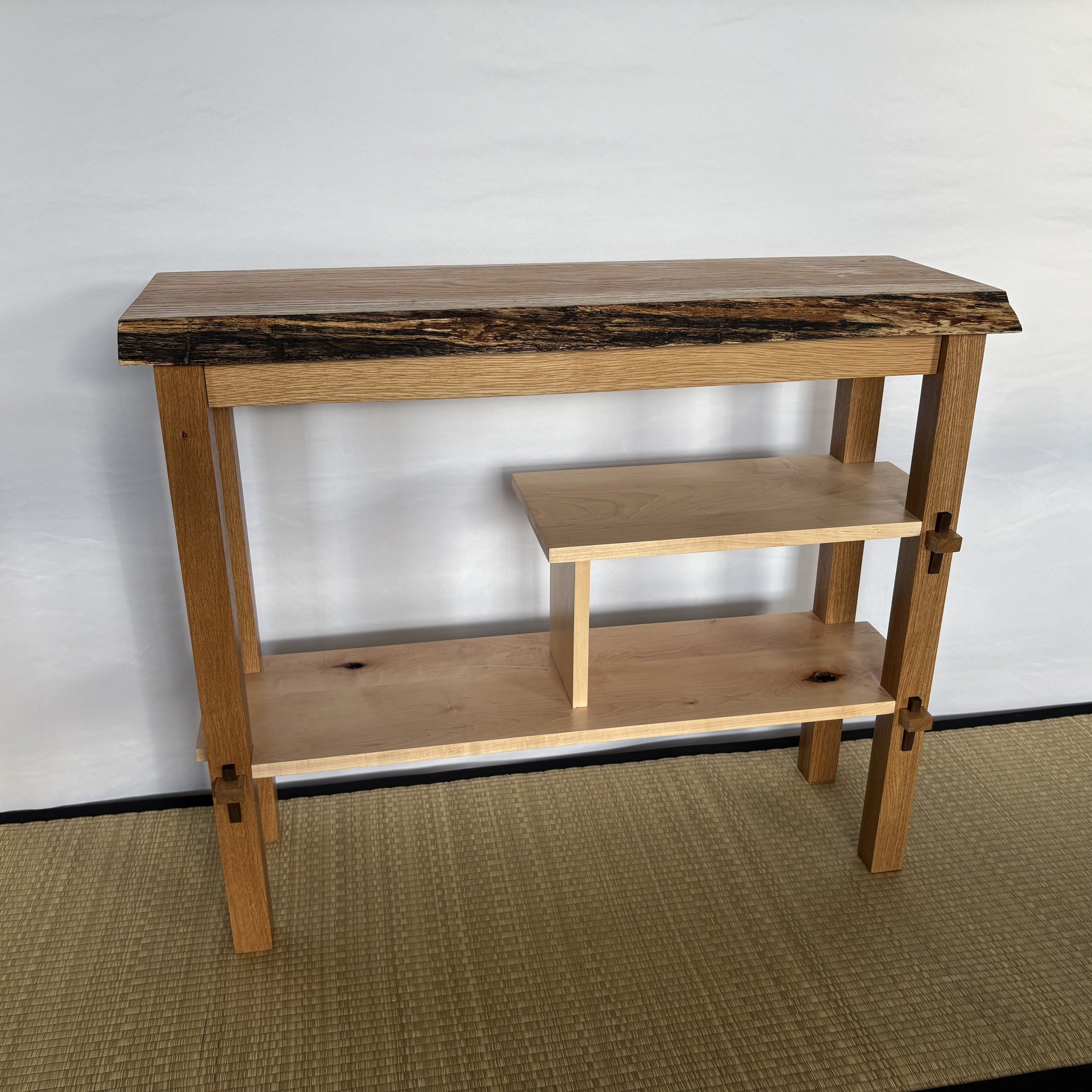
The result is a 36-inch-long console table combining a live edge oak top, solid oak structure, hard maple staggered shelving, and walnut tusk-tenon wedges.
A Lighter Material Palette
Oak became the natural starting point for the piece.
Depending on the board and finish, oak can carry medium brown, golden, and slightly gray tones that pair especially well with reclaimed or weathered wood. It gave the table enough warmth to feel natural without becoming visually heavy.
For the shelves, I introduced hard maple.
The lighter maple creates a softer contrast with the oak and helps brighten the center of the piece. Rather than making every structural element compete for attention, the shelves feel comparatively delicate and almost suspended inside the heavier oak framework.
Small walnut wedges provide the darkest accents in the composition. They are easy to miss from across the room, but up close they draw attention directly to the joinery holding the shelves in place.
The top itself came from a local woodworker and sawyer who happened to have oak slabs in almost exactly the dimensions I needed. I wanted to preserve the natural character of the live edge rather than clean it into something excessively polished. After removing the bark with chisels, I used a wire brush to clear the remaining material and thoroughly cleaned the cambium.
What remained was a dark, irregular streak running along the edge of the slab. It gives this particular table a slightly rustic character without turning the piece into rustic furniture.
Creating Rhythm Through Asymmetry
The biggest departure from the original design is the shelving.
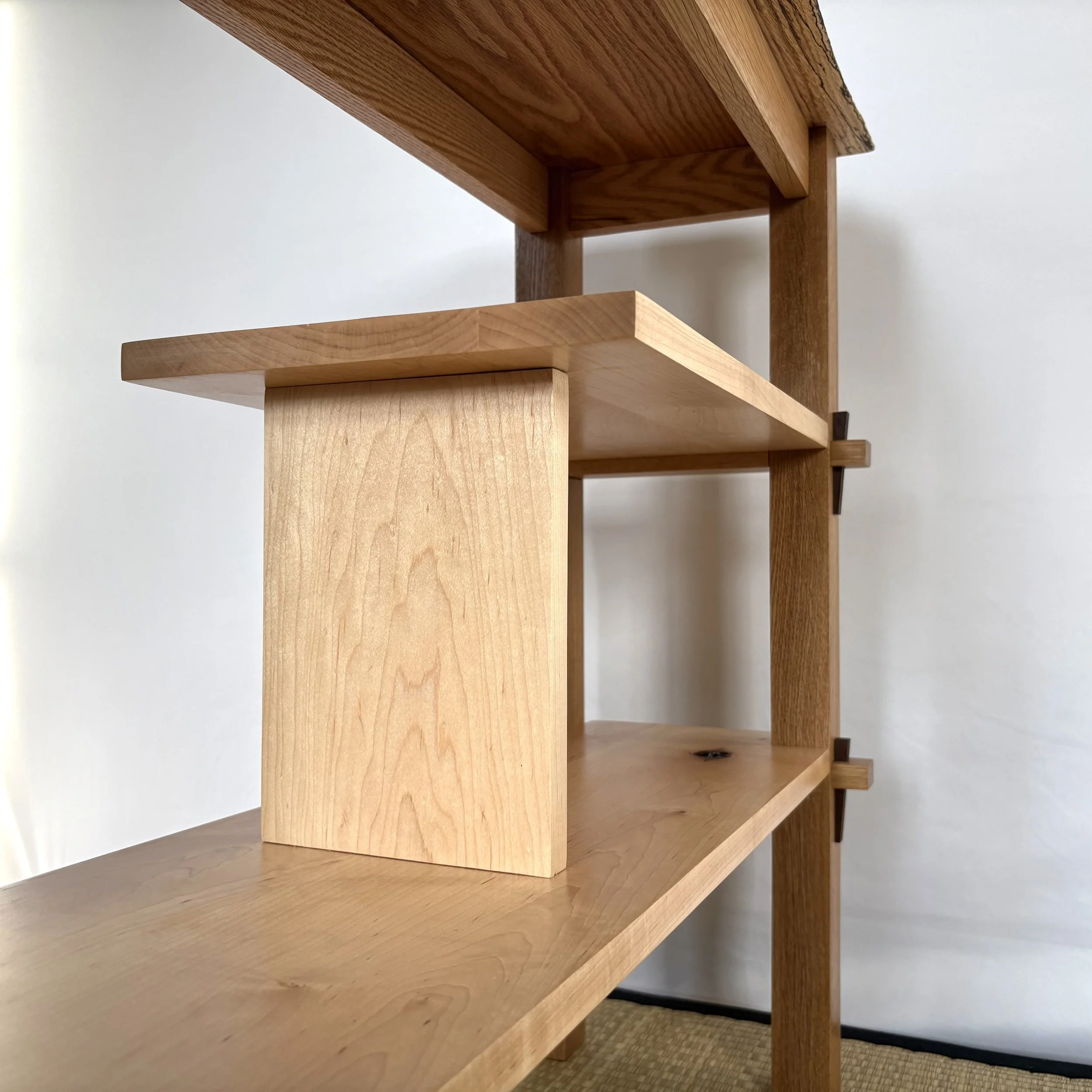
Rather than a single shelf running across the lower portion of the table, this version introduces two staggered maple shelves.
The arrangement is influenced by traditional Japanese shelving compositions, particularly tana, where staggered shelves are used within an alcove to display meaningful or decorative objects. What interests me about these arrangements is that asymmetry does not have to feel chaotic. Used carefully, it can create rhythm.
The eye moves from one shelf to the other instead of simply reading the furniture as a series of horizontal lines.
I used the golden ratio when positioning the lower shelf relative to the floor and tabletop. It is not something a viewer needs to consciously recognize, but using proportional relationships like this helps asymmetrical furniture feel deliberate rather than arbitrary.
The result is a table with a very simple overall silhouette, but a much more active interior.
Making the Structure Visible
Much of my furniture follows the same basic principle: if a joint is necessary to the structure, there is no reason it cannot also contribute to the design.
The oak legs meet the tabletop with traditional mortise-and-tenon joinery. The structural braces beneath the top are joined the same way.
The shelving system becomes more expressive.
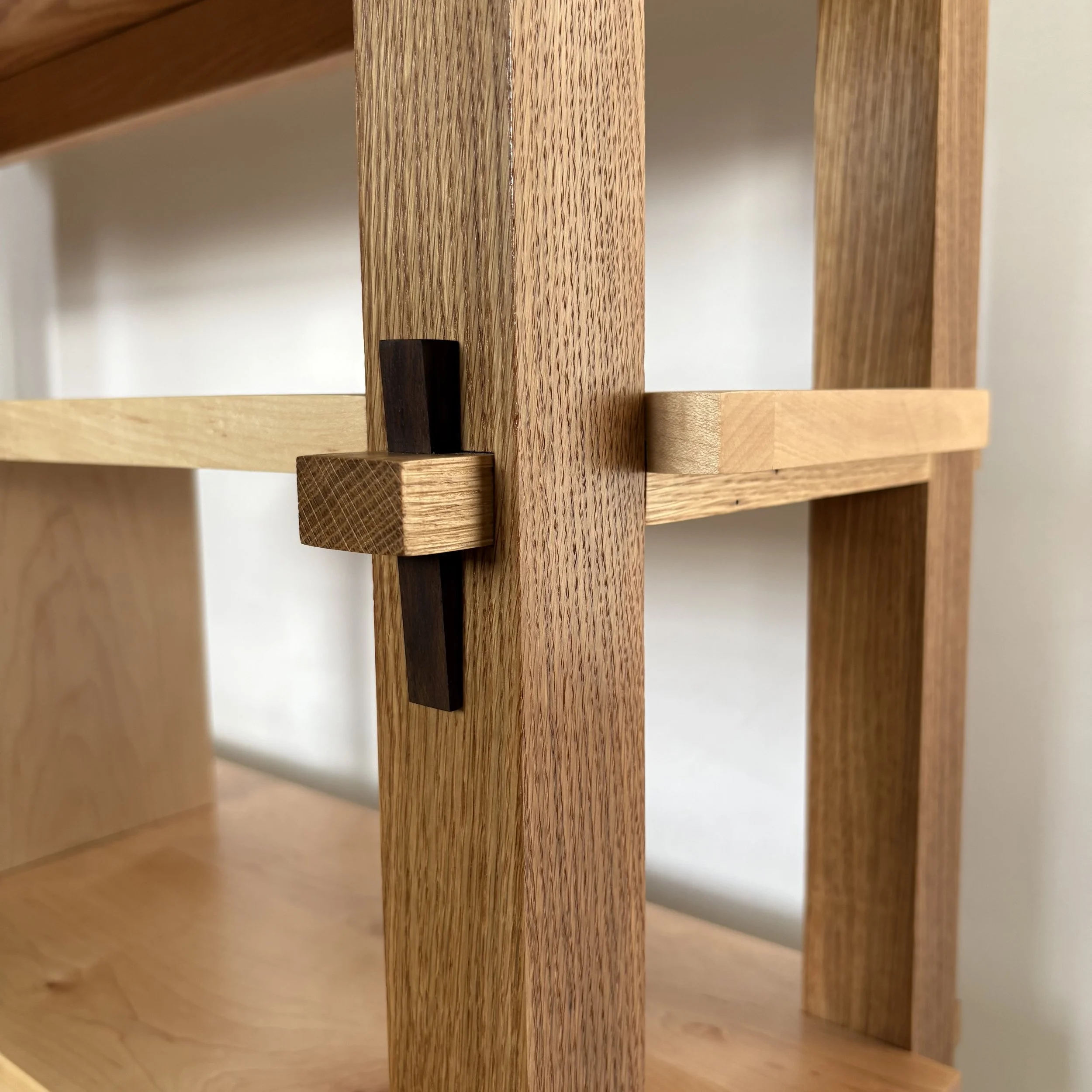
Grooves in the maple shelves locate them on support pieces that pass through the oak legs and lock into place with walnut tusk wedges. The upper staggered shelf then joins the lower shelving structure using additional mortise-and-tenon joints.
For this piece, I wanted the tusk tenons to remain visually restrained. They are approximately half the scale of the larger tusk joints I frequently use in bookcases and heavier furniture.
The walnut wedges were cut from 1/2-inch stock and given a relatively shallow angle, allowing the joint to retain enough material around the through-tenon while keeping the visible wedge compact.
That small scale matters. Oversized wedges would have overwhelmed such a narrow piece of furniture.
Instead, the joinery becomes something the eye discovers.
From across the room, the table remains clean and architectural. Up close, the construction begins revealing itself.
That balance between expressive structure and visual restraint is one of the ideas that defines much of my work.
Designed to Display
At 36 inches long, 30 inches tall, and 12 inches deep, this is intentionally a relatively narrow piece.
Its most obvious home is an entryway or living room where it can hold the kinds of smaller objects that help personalize a space: framed photographs, plants, books, ceramics, seasonal decorations, or collected objects.
The staggered shelving also creates some useful variation in scale.
One half remains relatively open for taller objects, while the stepped side creates smaller display areas for things that might otherwise feel lost on a large uninterrupted shelf.
It could just as naturally become a small bar or spirits display. A few bottles of whiskey and a set of specialized glassware would fit particularly well with the layered shelving.
The furniture provides structure without dictating exactly how it must be used.
Revisiting an Idea Rather Than Repeating It
This piece is especially satisfying to me because it shows how a design can evolve without losing its original identity.
The first version established the basic vocabulary: live edge, a narrow console silhouette, and exposed tusk-tenon shelving.
This version keeps those ideas while introducing better proportions, staggered shelving, contrasting species, more refined joinery, and considerably more developed craftsmanship.
That is generally how I prefer to approach repeatable designs.
A piece does not need to become frozen simply because I have built it before.

Available to Commission
This console is available as a repeatable design, however, as with the rest of my furniture, it does not have to be reproduced exactly as shown.
The overall length can change. Shelf positions can be rearranged or expanded. Additional shelves can be added. Different domestic species can be selected, and clients interested in something more unusual can commission the design in other hardwoods as well.
Elements of the shelving and joinery can also be adapted into entirely different pieces.
The configuration shown here begins at $3,750, with a typical lead time of approximately eight weeks. Simpler or smaller versions may cost less, while larger configurations, additional complexity, or exotic materials will increase the price.
If you have a space in mind, or simply like the idea but would want it interpreted differently, you can start a custom commission and develop the piece around your own home.
