Yūkyū: Giving a Century-Old Rosewood a New Life
Some materials ask very little of a design. Others demand that the design rise to meet them.
Yūkyū began with the wood.
The desk was not designed until I knew I wanted to acquire a small stock of Caribbean rosewood harvested sometime in the early 1900s. After roughly a century in storage, the material remained remarkably pristine: dense, defect-free, richly colored, and already shimmering under changing light before finish ever touched it. I knew almost immediately that I did not want to treat it as simply another attractive hardwood. I wanted to build something worthy of it.
That idea ultimately became Yūkyū, a name intended to evoke “enduring time.” The wood had already survived for approximately a century before becoming furniture. The desk became a way of giving that material another life, one intended to continue long after its first hundred years.
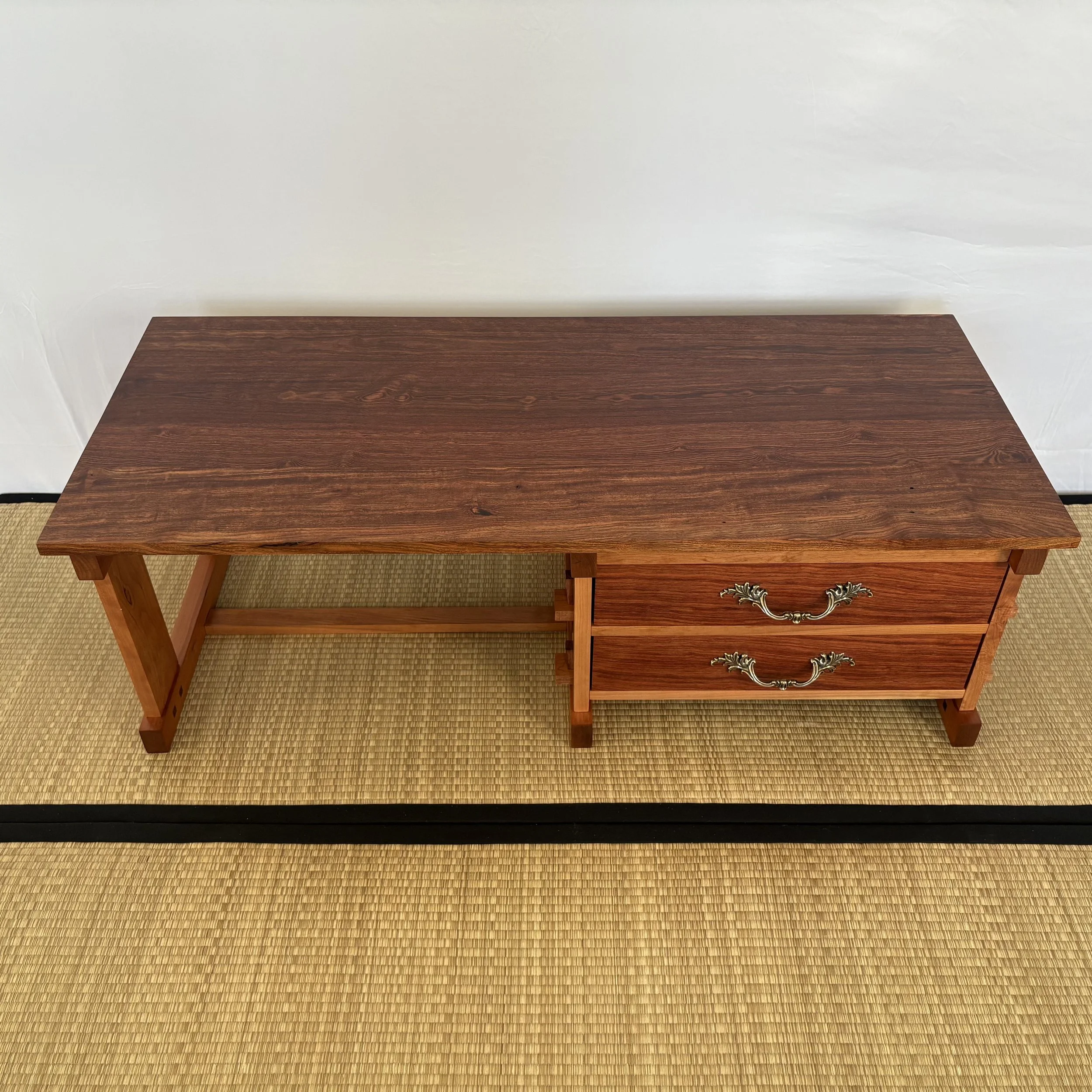
At 48 inches long, approximately 20¾ inches deep, and only 15 inches tall, Yūkyū is a floor-sitting writing desk designed around sitting in seiza or on a floor cushion rather than a conventional chair.
Designing Around the Material
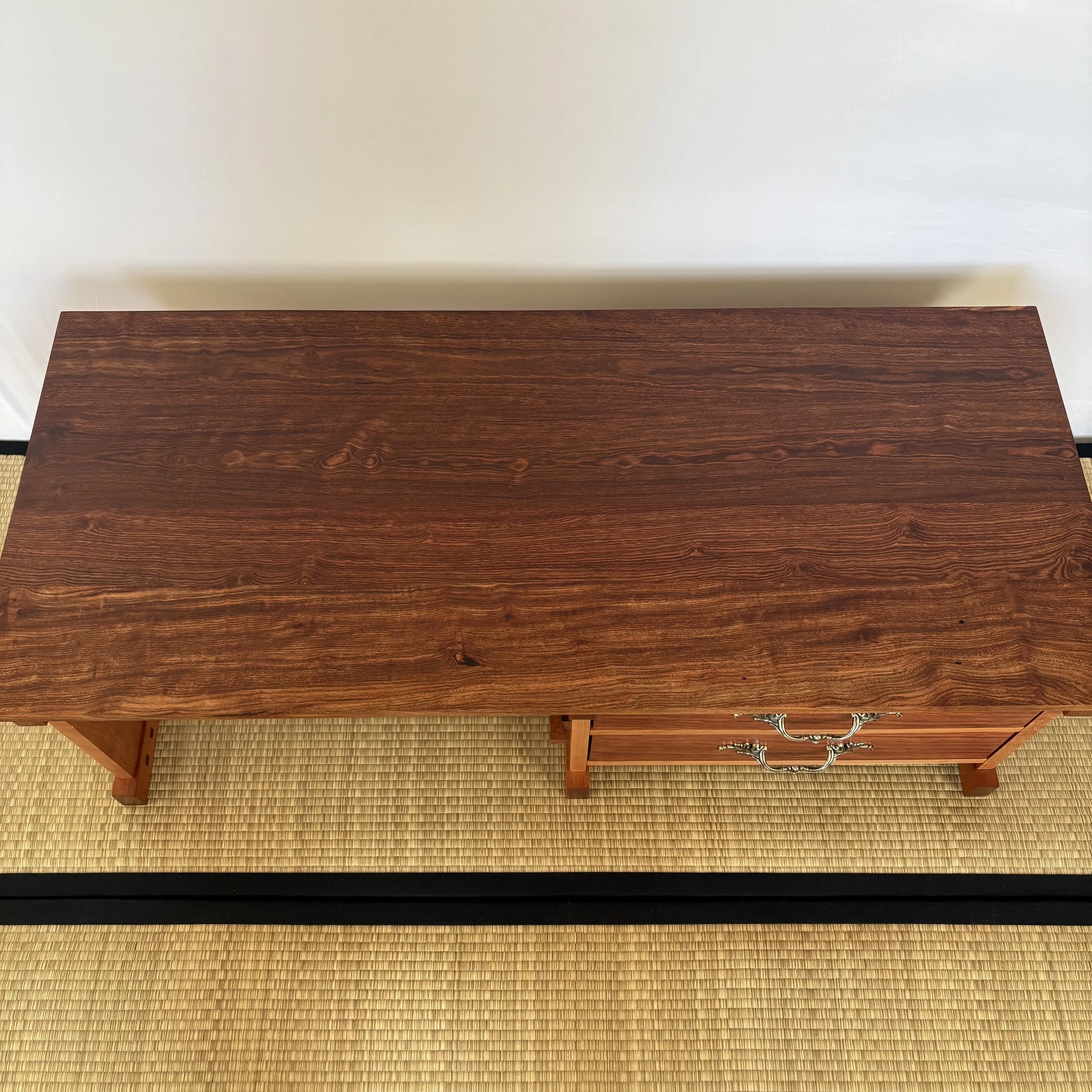
The desktop consists of four rosewood boards, each roughly five inches wide. They appear to have originated from the same tree, allowing the color and figure to move across the top with unusual continuity.
In person, the effect is difficult to capture completely in photographs. The grain seems to move as the light changes, with lighter fibers appearing beneath layers of warm brown and reddish color. I think of it almost like looking through stained glass: the surface has depth rather than appearing as a single flat shade of brown.
I paired the rosewood with cherry throughout the base.
Walnut would have been the obvious darker pairing, but I felt it would compete too strongly with the rosewood. Both could eventually settle into similar dark-brown territory, diminishing the distinction between them. Cherry gave me something warmer and lighter. It complements the underlying warmth of the rosewood without trying to become the focal point itself.
The pairing should also improve with age. Cherry gradually develops a deeper reddish-brown tone, while the rosewood should continue toward a rich brown. Over time, I expect the two materials to become increasingly harmonious while remaining visually distinct.
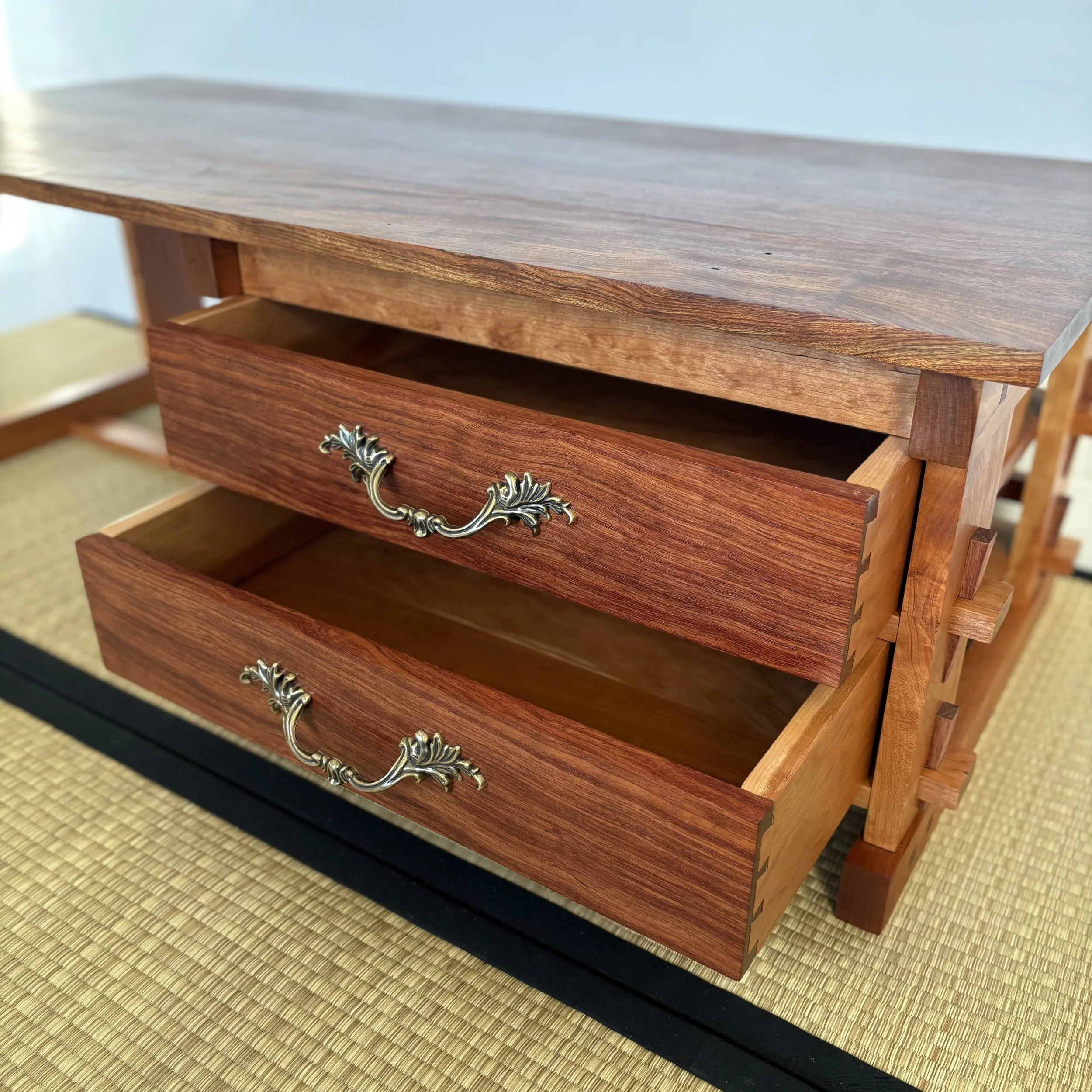
The desktop and drawer fronts are Caribbean rosewood. The remainder of the base and the drawer interiors are cherry, while smaller structural pegs and wedges return to rosewood as accents. Antique-style brass drawer pulls provide the only metal visible in the composition.
Why a Floor-Sitting Writing Desk?
I wanted the desk to encourage a particular kind of use.
The rosewood felt like a material suited to reflection and focus, so rather than building a conventional workstation, I looked toward the floor-sitting furniture traditionally found in Japanese interiors. The low height changes the relationship between the person and the furniture. It feels more intimate and deliberate than sitting behind a large conventional desk.
Yūkyū is intended for reading, handwriting, calligraphy, and the quieter work I do away from technology. Its drawers are sized primarily around calligraphy supplies, including paper, brushes, ink, pens, and a protective mat. I intend to use it for writing certificates of authenticity as well.
I can easily imagine an afternoon at the desk with a book, oolong tea, and a calligraphy set.
I do not intend to use a computer there.
That use informed the entire character of the piece.
Asymmetry Born From a Constraint
Interestingly, Yūkyū was not originally supposed to look like this.
My first drawing assumed that I had another foot of usable rosewood. That version was symmetrical, with drawers positioned on both sides of the writing area.
Once I realized the desktop stock was limited to four feet, the design had to change.
Instead of fighting the constraint, I concentrated the storage on one side and left the other side completely open for sitting. The asymmetrical arrangement maximized both storage and legroom while ultimately giving the desk considerably more character than the original symmetrical drawing.
Even another accidental change improved the final piece.
I had originally planned the trestle base with the vertical supports 16 inches apart. During construction, I accidentally positioned them an inch farther outward on each side. That meant several drawer and shelf components I had already prepared were no longer deep enough.
Rather than rebuilding everything, I altered the shelving and inset the drawer stops. The wider stance ultimately made the base look better, so what began as a construction error became a design improvement.
Making Construction Part of the Composition
Yūkyū is one of the most joinery-intensive pieces I have built.
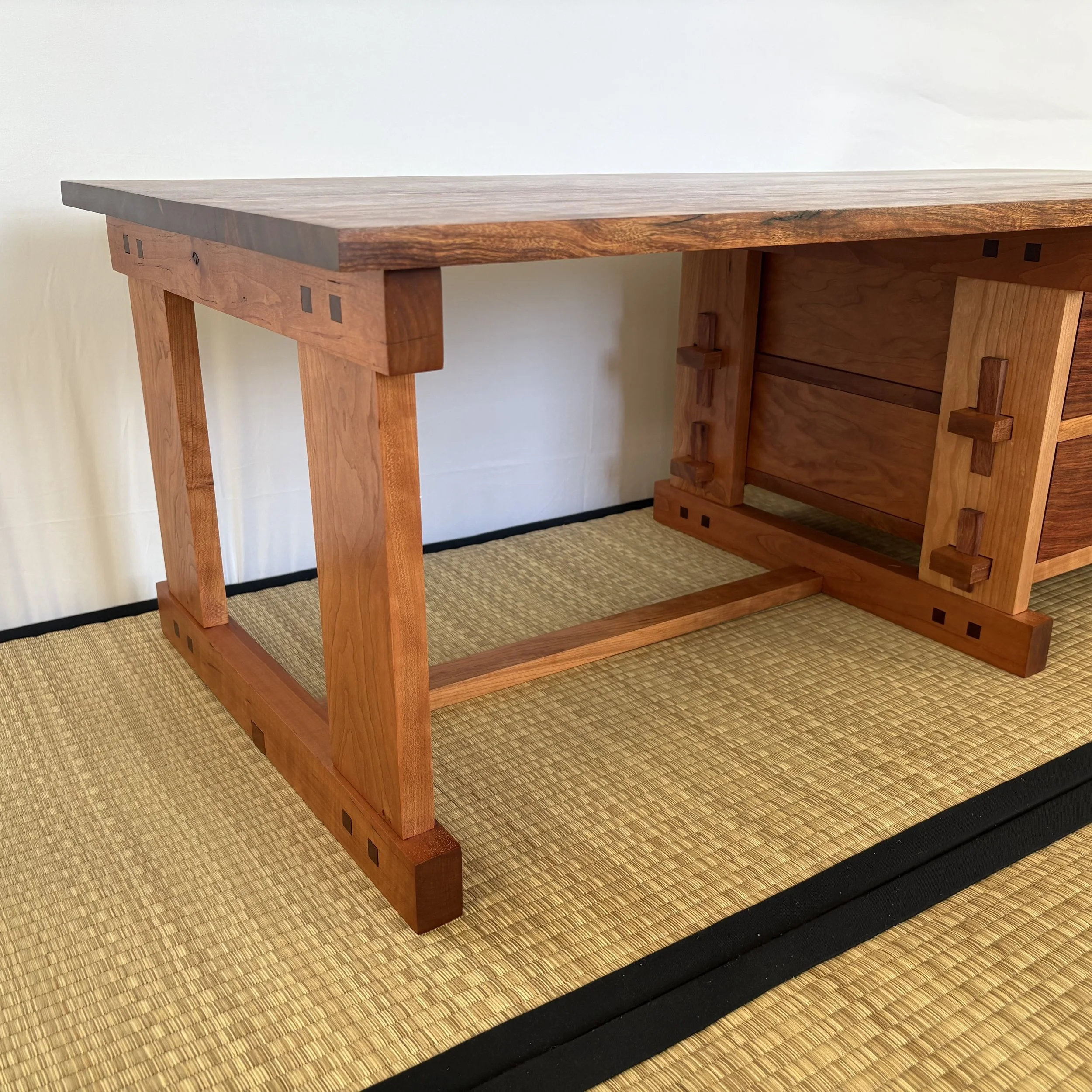
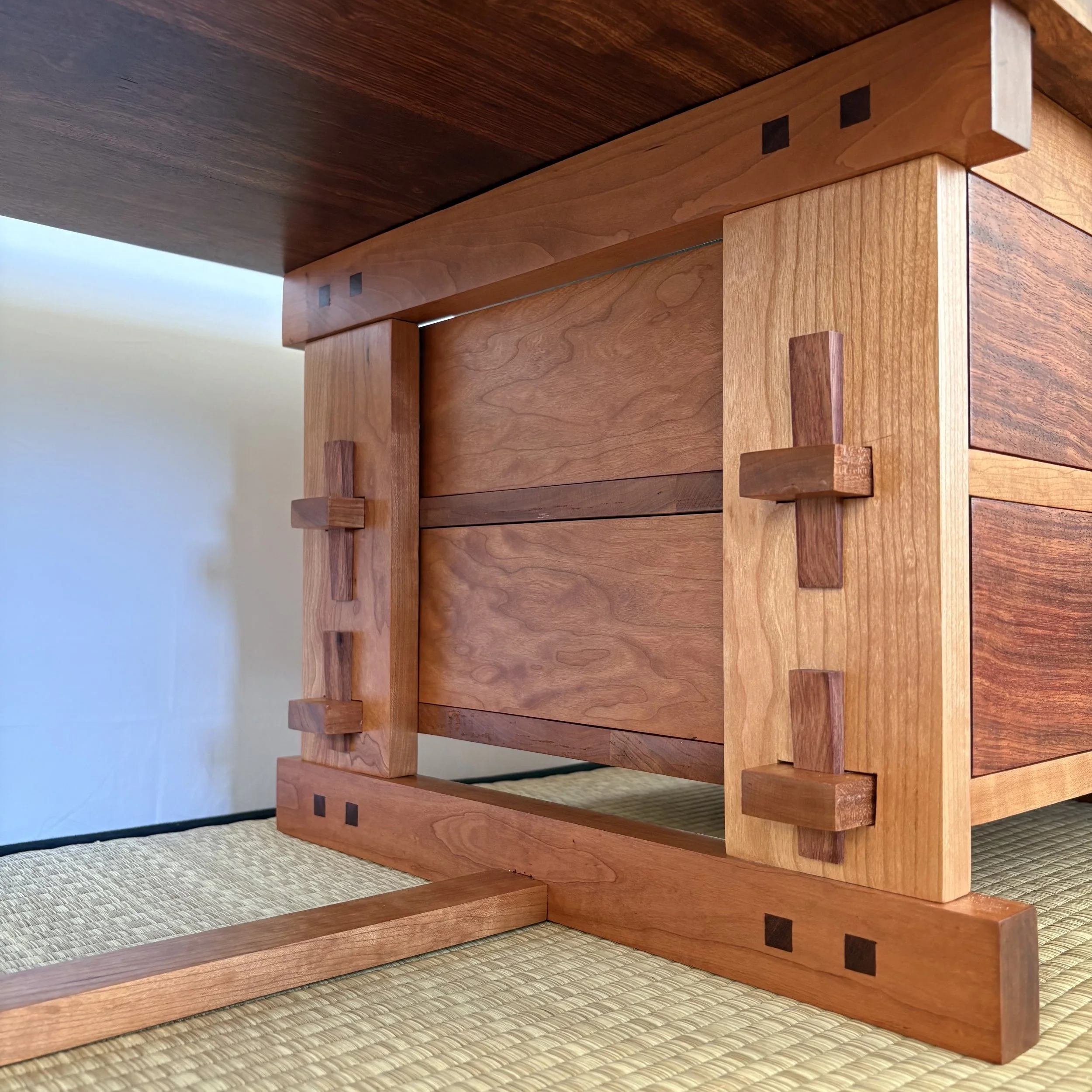
The base uses pegged through-tenons similar to those found in my trestle tables. The drawer shelves connect to that base through exposed tusk-tenon joinery, while the drawer fronts themselves are joined using hand-cut half-blind dovetails. A floor-level brace keeps the open sitting side rigid, compensating for the absence of the drawer structure that stiffens the opposite side.
On paper, this sounds like an excessive amount of visible construction.
In person, I think it works precisely because the rosewood is so visually powerful.
The desktop immediately commands attention. So do the drawer fronts. Had I made the base extremely restrained, it would almost disappear beneath them. The more expressive joinery gives the cherry structure enough visual weight to coexist with the rosewood without trying to overpower it.
That balance is central to my work.
I like furniture with clean silhouettes and restrained overall forms, but I also believe that construction deserves to be visible. Pegs, wedges, dovetails and through-tenons turn something normally concealed into part of the visual composition.
Yūkyū pushes that principle further than most of my previous work.
Cutting Into Irreplaceable Wood
The half-blind dovetails were probably the most intimidating operation in the entire project.
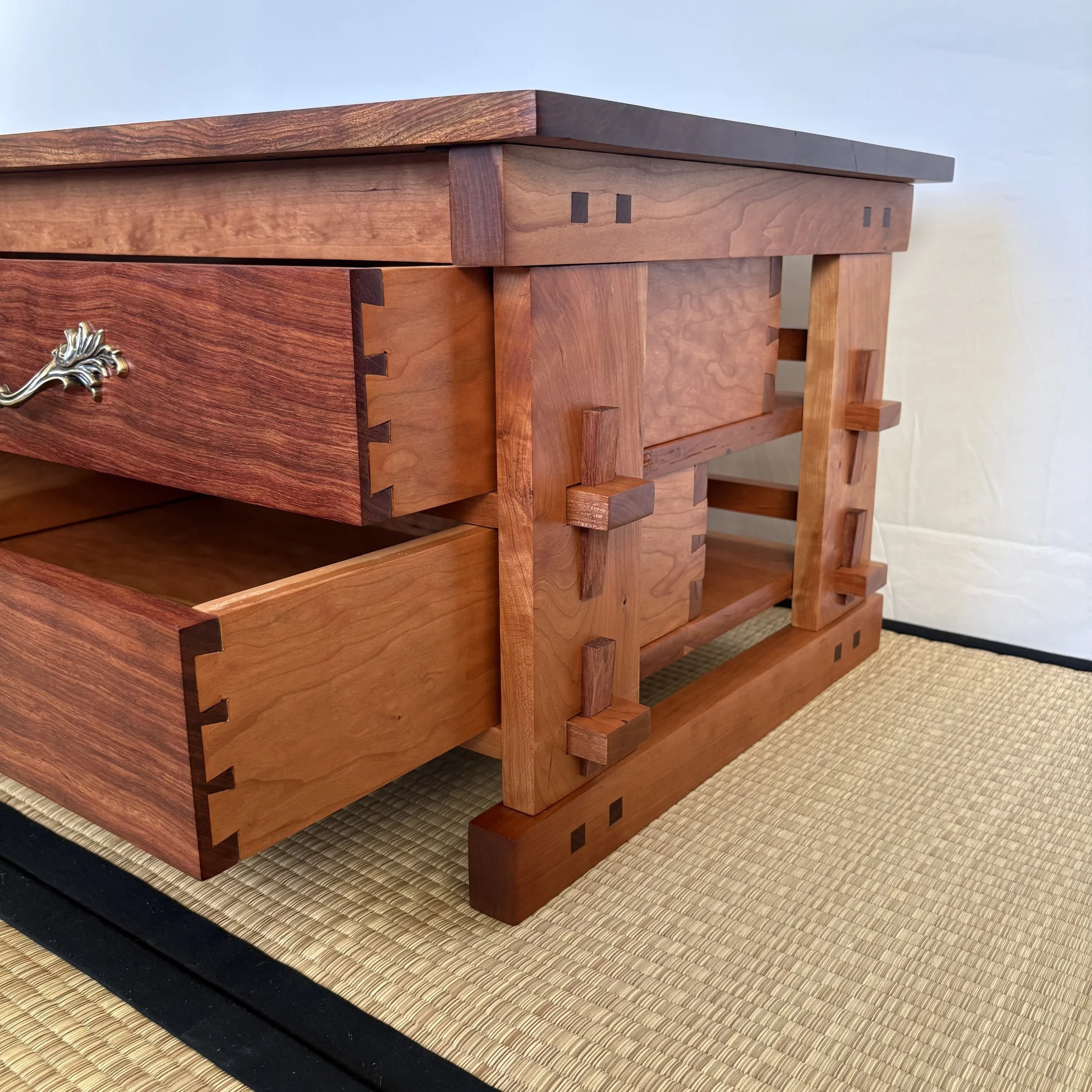
They were cut entirely by hand, and I chose the joint specifically because it hides the dovetail from the front. That allows each rosewood drawer face to remain visually uninterrupted while still using a traditional mechanical joint behind it.
The problem was that I had never cut half-blind dovetails before. I had also never cut joinery in Caribbean rosewood. And I had no spare board.
A significant mistake would not simply have meant preparing another drawer front. I had purchased and used all of the suitable rosewood available to me. If I ruined one, my only realistic option would have been to cut the damaged material shorter and redesign the drawers around what remained.
So I trusted my skills, slowed down, checked the layout repeatedly, and paid careful attention to how the unfamiliar wood behaved under a chisel.
The dovetails came out successfully.
Ironically, they were not even the hardest part of the build.
That distinction went to the small square rosewood pegs throughout the base. Rosewood is dramatically harder than cherry, so an oversized peg could split the surrounding structure rather than compress enough to accommodate a slight discrepancy. Each mortise and peg had to be gradually refined until the fit was neither loose nor dangerously tight. That process took hours of careful chiseling and incremental sanding.
Nowhere to Hide
The drawers also gave me an opportunity to explore another idea that matters to me: hidden surfaces deserve the same respect as visible ones.
Rather than enclosing the drawer boxes inside a separate cabinet shell, I designed them so that the cherry drawer sides remain visible from the exterior.
Furniture makers sometimes reserve their finest material for visible faces and use cheaper or less attractive wood where they assume nobody will look. This design deliberately gave me nowhere to do that.
The cherry inside the drawers is material I would happily display on the outside of a piece of furniture. Every surface received the same standard of material and craftsmanship whether it is immediately obvious or only discovered when a drawer is opened.
There is something I enjoy about that.
It is easy to care deeply about the focal point because everyone will see it. Maintaining the same standard where nobody may notice requires a different kind of discipline.
Rosewood, Brass, and an Older Furniture Tradition
The antique-style brass pulls were intentionally more decorative than the hardware I normally use.
Although the particular pulls have a French-inspired design, I wanted their older character to reinforce the scholarly, traditional feeling of the desk. Combined with rosewood, they allowed me to reference the old-world association I wanted the piece to carry, particularly my interest in Chinese furniture traditions where valuable hardwoods and scholarly furniture have long intersected.
The result is not intended to reproduce an antique Chinese or Japanese desk. It is still unmistakably a Flowing Water piece, but the rosewood, ornate brass, low writing format and visible traditional joinery allow the desk to acknowledge those older furniture traditions without simply copying them.
Built to Age
The desk was finished with Osmo hardwax oil, followed by a ceramic nano coating on the desktop for additional resistance to moisture and ink.
Applying finish transformed the rosewood more dramatically than almost any material I have worked with. The color deepened and the already-present chatoyance became considerably stronger, giving the grain an almost shifting appearance as the light moves across it.
Because the desktop is solid wood, it also has to be allowed to move.
I attached it with figure-eight fasteners rather than rigidly screwing it to the base. These fasteners secure the top while still allowing seasonal expansion and contraction, reducing the risk of warping or cracking as humidity changes.
Even the drawers were fitted with seasonal movement in mind.
They were initially just slightly too tight and required removing roughly 1/32 to 1/16 inch from their tops. Because Appalachian summers tend to be humid and winters dry, a relatively tight summer fit should become slightly freer as the wood contracts during winter.
Yūkyū was designed not merely to survive that movement, but to age into it.
A Personal Collection Piece
This particular desk is not for sale.
The material is effectively irreplaceable, and the dimensions were developed around my own space, body, habits, and calligraphy supplies. For those reasons, Yūkyū will remain part of my personal collection.
But the design itself is absolutely something I would revisit for a client.
A future version could be made taller for a conventional chair, widened or shortened for a particular room, redesigned around different drawer requirements, given open shelving, or built around an entirely different precious hardwood.
I still have access to other unusual old-stock woods, and contemporary options could include species such as ziricote, ebony, cocobolo, kingwood or other rosewoods where appropriate. A domestic hardwood such as walnut could also make the design significantly more accessible while preserving the same architecture and joinery language.
For reference, Yūkyū is valued at approximately $14,500 in its present configuration, largely because of the century-old rosewood and the complexity of construction. A similarly complicated desk in familiar domestic hardwoods might begin closer to $6,000, while commissions involving comparably rare materials could approach the price of Yūkyū. Typical lead time for work of this complexity would be approximately 8 to 12+ weeks.
Rare Materials Deserve Rare Designs
More than anything else, that is what I want Yūkyū to represent.
When a material has survived for a century before ever reaching my shop, I think it deserves more than the easiest possible construction.
I could have taken this rosewood, made a rectangular top, screwed metal legs underneath it and still produced an attractive desk.
But that would have felt like a waste.
Rare materials deserve designs worthy of them. They deserve craftsmanship that treats their scarcity as a responsibility rather than simply a selling point.
That occasionally means taking risks, cutting difficult joinery into wood that cannot simply be replaced, or designing an unusually complex structure because a simpler one would not do the material justice.
Yūkyū also reminds me that my design language does not have to be confined to the furniture categories I have already explored. The same structural vocabulary can move from tables and bookcases into desks, cabinets, dressers, credenzas and whatever comes next.
The material may have begun its story a century ago.
I hope the desk is still somewhere, being used, a century from now.
Interested in Creating Something of Your Own?
Yūkyū will remain in my personal collection, but its design language, materials, proportions, and storage can all be adapted into a one-of-a-kind commission.
