A Marblewood Bench Shaped by Time
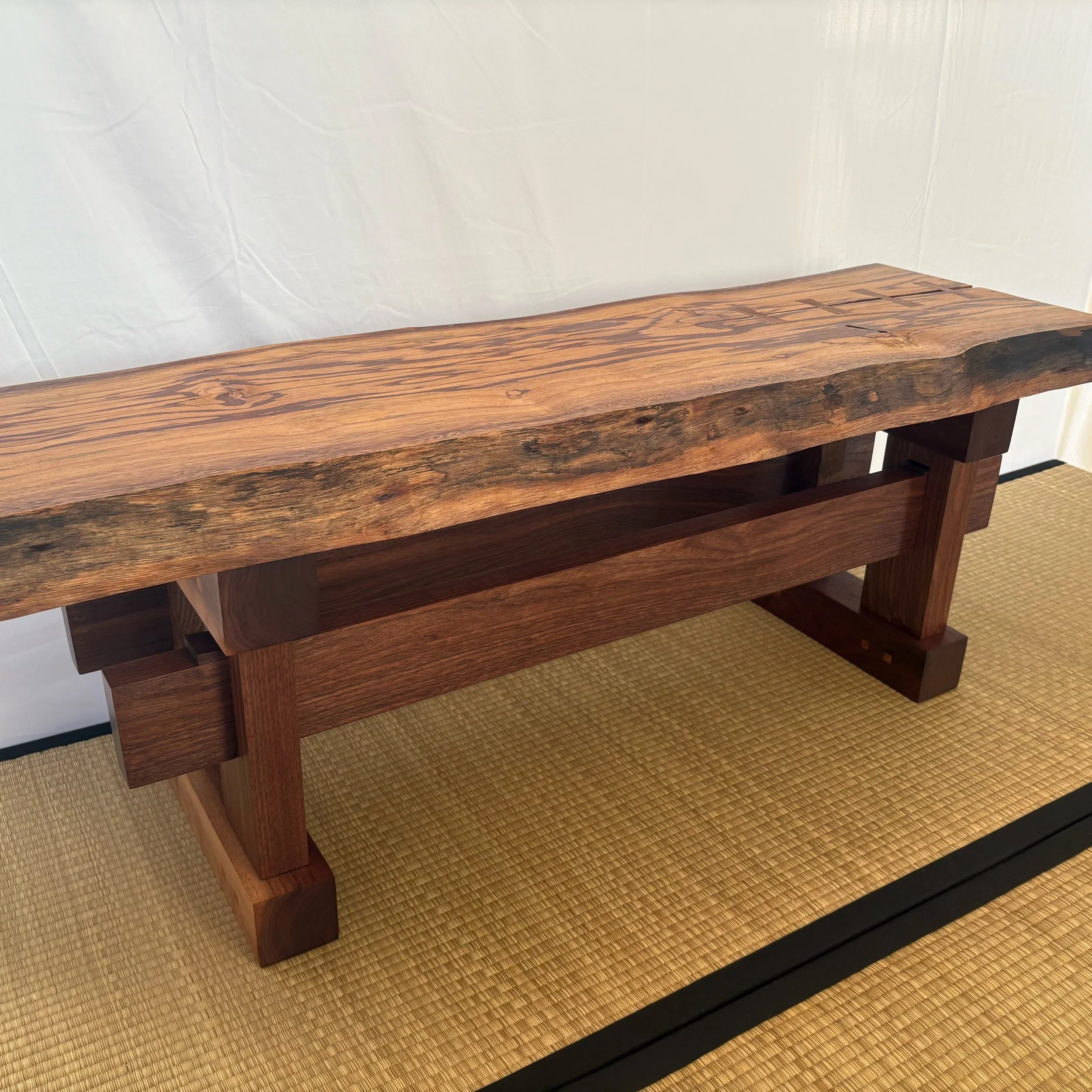
Bench with marblewood slab top and architectural walnut base, named Mujō 無常
Some pieces begin with a drawing. Mujō began with a slab.
I encountered this marblewood online while searching for unusual pieces of wood. It was considerably more expensive than the other slabs available, but I had wanted to work with marblewood for some time. Its dramatic grain and color were unlike anything else I had seen, and this particular slab was substantial enough to become something significant: nearly 2½ inches thick, four feet long, and dense enough to feel more like stone than timber.
I did not yet know exactly what it would become. I only knew that the material deserved to become a serious piece of furniture.
A Material Between Wood and Stone
The defining feature of marblewood is its grain. Dark brown and nearly black veins move through a field of warm golden brown, creating patterns that resemble polished stone, mineral deposits, or layers of earth exposed over time.
Its appearance is only part of its presence. The first time I seriously maneuvered the slab while applying the finish, its weight caught me off guard badly enough that I pulled my shoulder. Although the slab is only four feet long, it demands proper lifting form and deliberate movement.
It does not merely look like stone. It feels like stone.
Yet marblewood possesses something stone does not: the unmistakable warmth of wood. Its color, texture, and natural variation still carry the record of a once-living tree. It combines the geological presence of stone with the warmth and individuality of timber, creating a character unlike almost any other material.
Working with it reinforced that impression. The density demanded extremely sharp tools when carving the bowtie mortises. Every chisel stroke was a reminder of the wood’s strength, and sanding took considerably longer than it would with a softer species.
That difficulty brought its own rewards. The hardness allowed the bowtie mortises to retain crisp, square edges without denting or crumbling. Once sanded and finished, the surface polished beautifully, and the grain became even richer and more vivid beneath the hardwax oil.
Marblewood asks more of the maker, but it gives something remarkable in return.
Designing Around the Slab
I completed much of the slab months before designing its base.
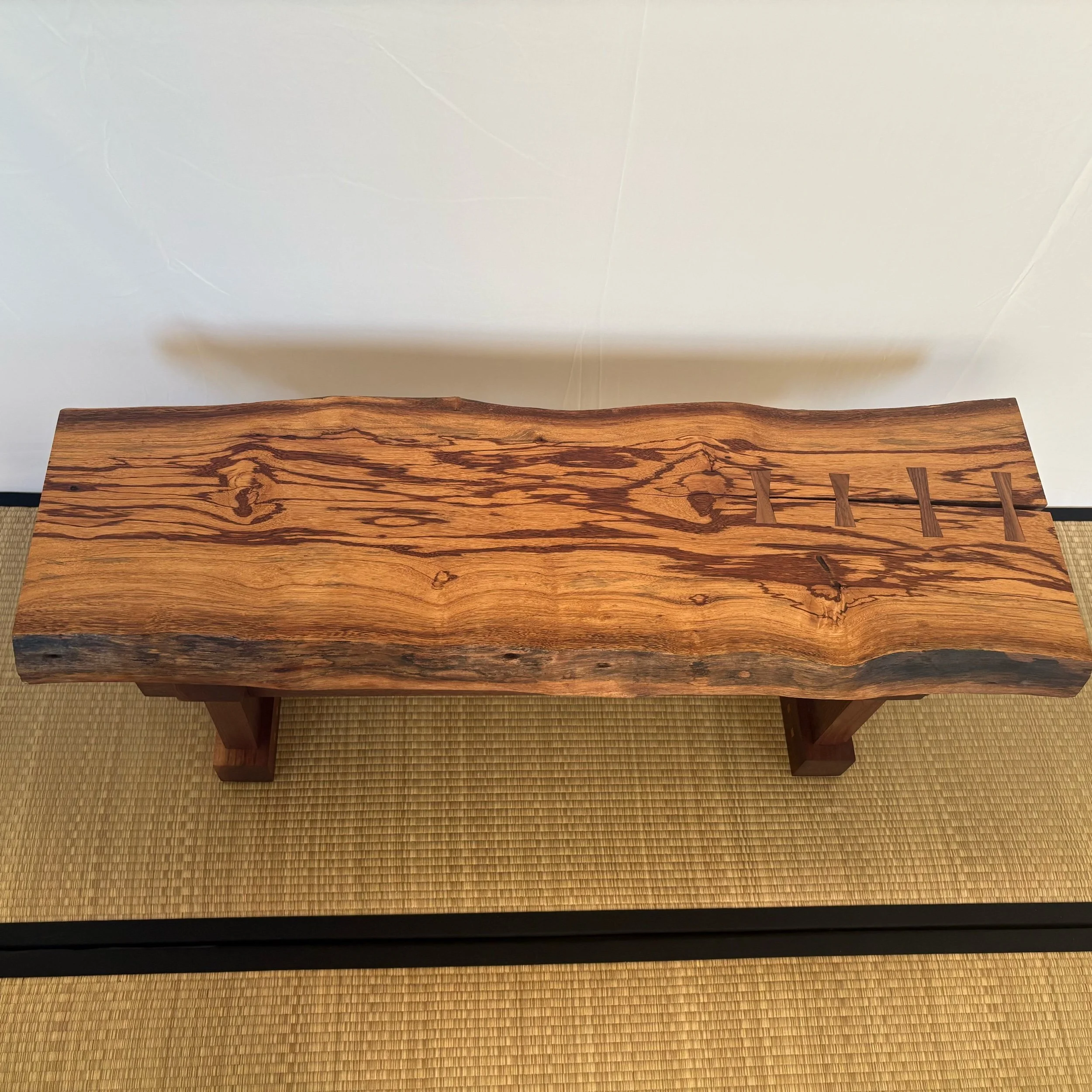
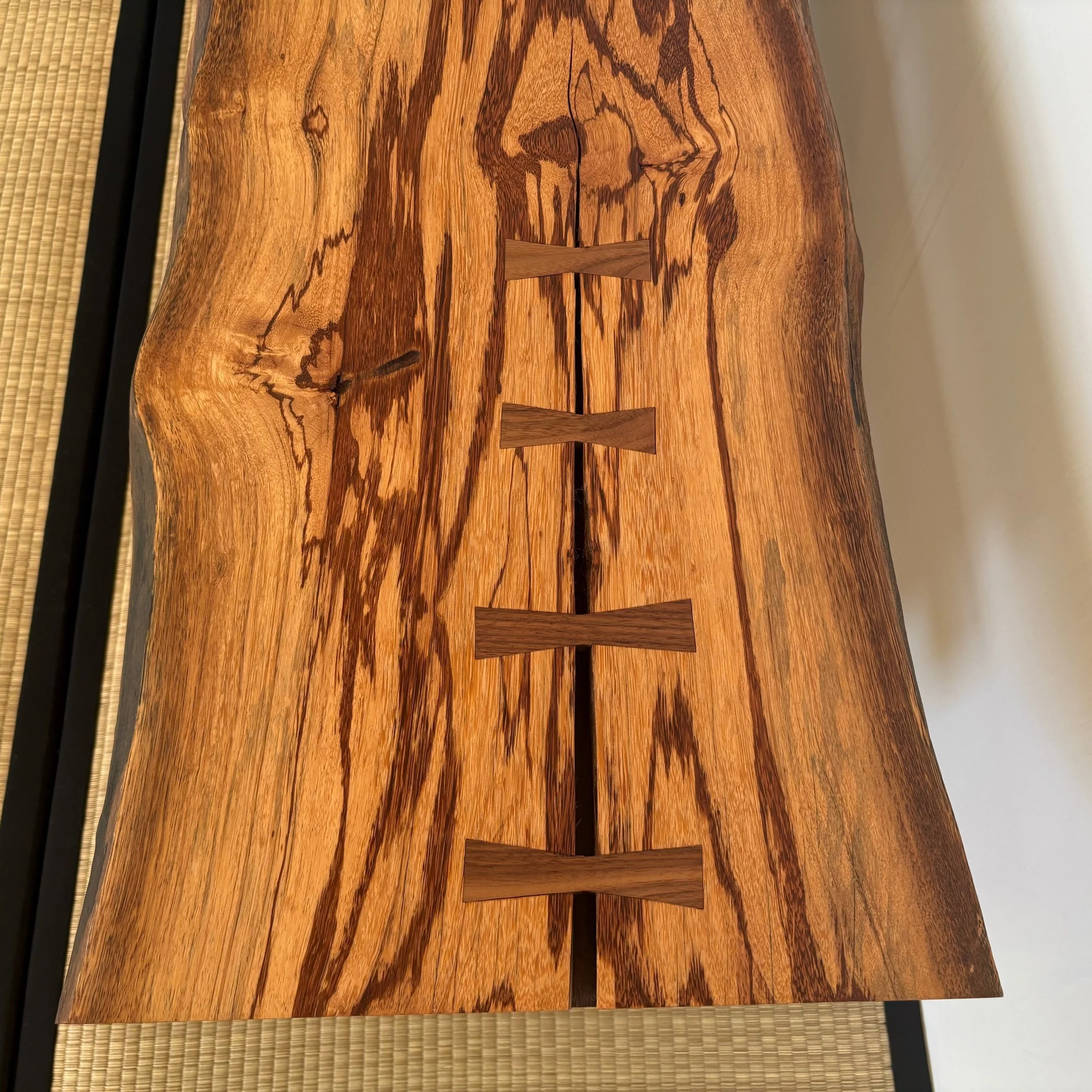
The natural fissure was stabilized with four walnut bowties, the surface was sanded, and the hardwax oil finish was applied while I was still uncertain whether the piece would become a bench or a coffee table. Finishing it early also reduced the amount of time the raw slab spent exposed to changing shop conditions, helping preserve the remarkable flatness it had when it arrived.
Rather than forcing an immediate decision, I spent time with the material.
Eventually, I designed Mujō to serve both functions. At 18 inches tall, 15 inches wide, and four feet long, it is proportioned as a comfortable bench while remaining low and open enough to function as a narrow coffee table or display surface.
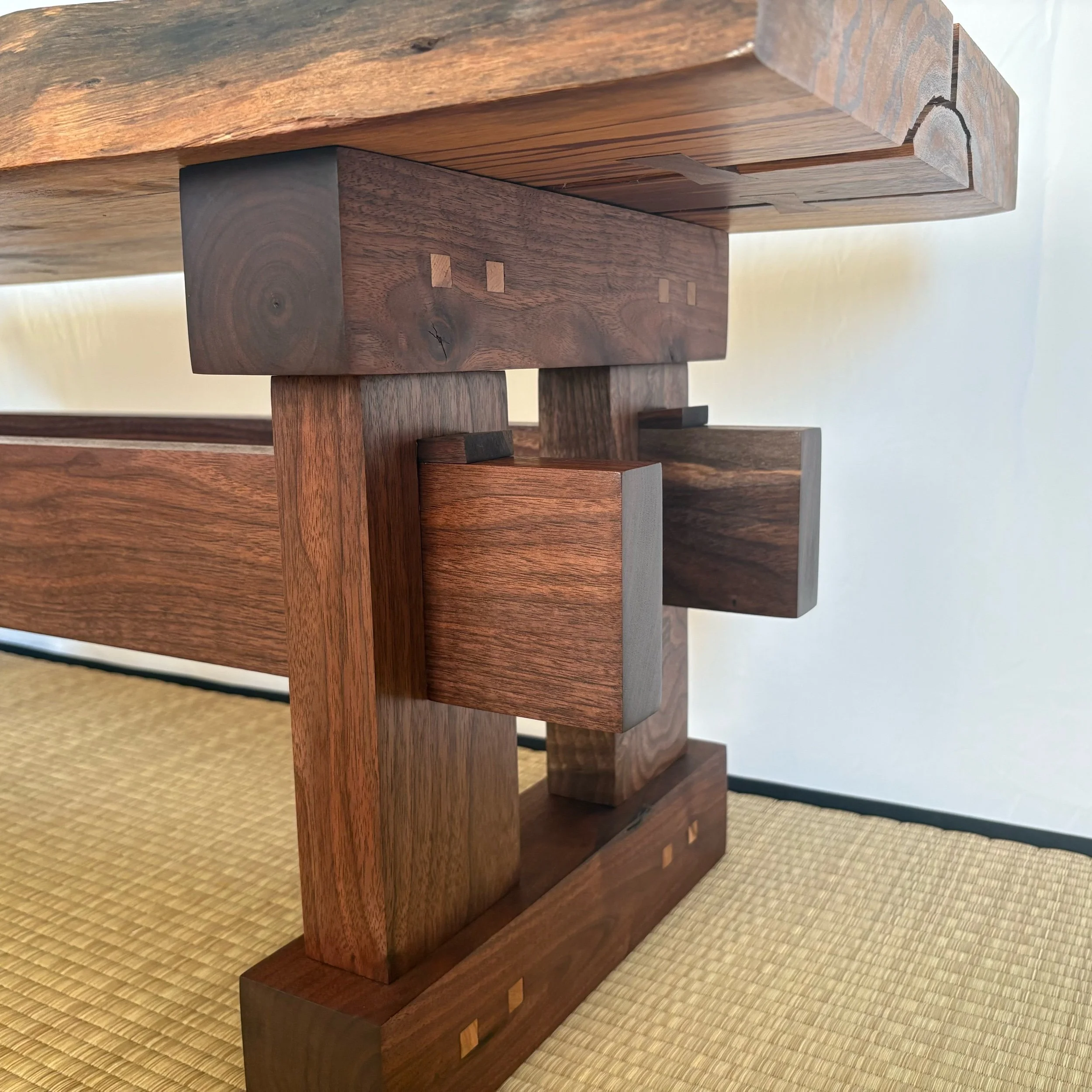
The base emerged as a heavier, more architectural adaptation of trestle forms I had used previously. It is built primarily from walnut, with massive 3-by-3-inch cleats at the top and bottom, which are the thickest structural members my current tools can reasonably process.
Two offset horizontal stretchers connect the opposing frames. This is the first base I have designed with two stretchers rather than one.
Their purpose is both structural and visual. The additional stretcher increases the weight of the base, helping it balance the unusually heavy slab. It also improves resistance to racking and twisting when people sit, stand, or apply uneven pressure to the bench. A single stretcher may have left the finished piece feeling excessively top-heavy.
During assembly, I tested the base by standing with one foot on each stretcher. I then shifted my full weight onto only one side, placing a twisting force on the frame. It did not move. The joinery resisted both downward pressure and uneven loading without any perceptible racking.
The base needed to look capable of carrying the slab because it genuinely had to be.
A Roof Supported by a Frame
The slab extends generously beyond the base, creating a broad overhang at either end. Visually, this makes the top feel almost roof-like, as though the walnut structure is a miniature timber frame supporting a heavy architectural canopy.
That relationship was intentional. A base this substantial needed to support something that appeared equally powerful. Reducing the overhang would have made the slab and base compete for visual dominance rather than allowing them to read as distinct but connected layers.
There was also a practical reason for the placement. The fissure and walnut bowties occupy one end of the slab. By keeping the base farther inward, I could place the fasteners only through solid areas of marblewood, avoiding any risk of driving a screw through a bowtie or compromised section of the slab.
The proportion between the marblewood top and the 3-by-3-inch walnut cleats became one of my favorite details. The cleats look fully capable of supporting the slab without becoming so large that they overwhelm it.
The base grounds the marblewood rather than competing with it.
Rhythm Instead of Symmetry
The stretchers are not vertically centered. Their placement follows the golden ratio, a proportion that appears repeatedly throughout my work.
Perfect centering can create a rigid and static feeling. By placing the horizontal elements according to the golden ratio, the structure gains a sense of movement while remaining balanced. The paired stretchers and their supporting uprights also create rhythm and visual layering across the length of the bench.
Small hickory pegs provide a gentler point of contrast against the walnut.
I considered the color carefully. Pale maple would have created a much sharper interruption against the chocolate-brown base. Hickory has a warmer golden tone that remains visible without shouting for attention. It also echoes the lighter colors found throughout the marblewood slab, quietly connecting the top and base.
The pegs reveal the locations of the hand-cut mortise-and-tenon joints. Modern adhesives mean that a properly fitted mortise and tenon can be extremely strong even without pegs, so their role here is partly traditional and partly expressive. They allow the construction to remain visible rather than concealing how the structure was assembled.
Preserving the Crack
The fissure running through one end of the slab could have been removed, filled with epoxy, or hidden.
I chose none of those options.
Instead, four walnut bowties span the opening and prevent it from widening or shifting over time. These inlays are among the most structurally important details in the entire piece. They stabilize the slab while leaving its history visible.
The crack is not treated as damage that must be disguised. It is evidence of the tree’s life and the changes the material experienced before reaching my shop.
That decision became central to the meaning of the finished work.
The Meaning of Mujō
Mujō is the Japanese concept of impermanence, the understanding that nothing remains unchanged forever.
At first glance, that name may seem contradictory. This bench is exceptionally heavy, dense, and strongly constructed. It feels monumental and almost permanent.
But its present form is the result of continuous change.
The veining was formed through the tree’s growth. The live edge, color variation, weathered areas, and fissure all record the passage of time. The walnut base came from trees shaped by their own environments. Even now, after the application of finish and the addition of stabilizing joinery, the wood will continue to age and its colors will gradually evolve.
My design did not attempt to erase those changes or force the slab to conform to a predetermined image of perfection. The fissure was repaired rather than removed. The natural edges were retained. The grain was allowed to determine where attention would fall.
The finish and joinery capture the material at this particular moment, but they do not make it permanent.
Mujō is a reminder that strength and impermanence are not opposites. Something can feel enduring while still bearing the evidence of everything that changed to bring it into existence.
A Monumental Piece for a Quiet Interior
Mujō has a presence that feels architectural, sculptural, and natural. Its mass is immediately apparent, but the open base prevents it from feeling visually immovable.
I imagine it primarily as an entryway bench or entry display table, where it could establish the character of a room immediately. It could also serve as a coffee table, particularly in a narrower room or in an interior where open space is preserved around the furniture.
The piece is best suited to a relatively minimal environment containing natural materials. Mujō was designed to anchor a room and provide a place for the eye to rest. In an overly crowded space, its grain and layered structure would have to compete with too many surrounding elements.
Placed among stone, plaster, natural textiles, restrained architecture, and open space, its live edge and dramatic figure could feel fully at home.
A New Direction for Flowing Water Woodworking
Mujō represents a continued shift in the direction of Flowing Water Woodworking toward rarer materials and increasingly individual pieces.
I believe my work is strongest when an exceptional focal material is paired with a grounding structure. In this case, the unusual marblewood is supported by familiar walnut, allowing the rare material to command attention without feeling disconnected from the rest of the piece.
Only one other slab from this particular marblewood tree is known to me, and marblewood slabs are rarely available in general. Trees appear to be milled only occasionally, and the resulting material can disappear from the market quickly.
That scarcity is part of what makes one-of-a-kind work meaningful. The exact grain, live edge, dimensions, fissure, and natural history of this slab cannot be duplicated. Another piece could explore similar ideas, but it could never be Mujō again.
Available as a One-of-a-Kind Piece
Mujō is currently available for purchase as a one-of-a-kind bench, coffee table, or sculptural entryway piece.
For those drawn to its ideas but needing different dimensions, materials, or functions, I also accept custom commissions. A project can begin with detailed measurements and a clearly defined purpose, or simply with a general feeling, material preference, or space that needs to be completed.
Existing designs can be adapted to suit a particular interior, or an entirely new piece can be developed around a rare slab or wood species. Through unusual material pairings, hand-cut joinery, and visible structural details, each commission is designed to possess an identity of its own.
Mujō began with a slab whose final purpose was unknown.
The next piece may begin with a room, a material, a practical need, or an idea that has not yet taken physical form.
